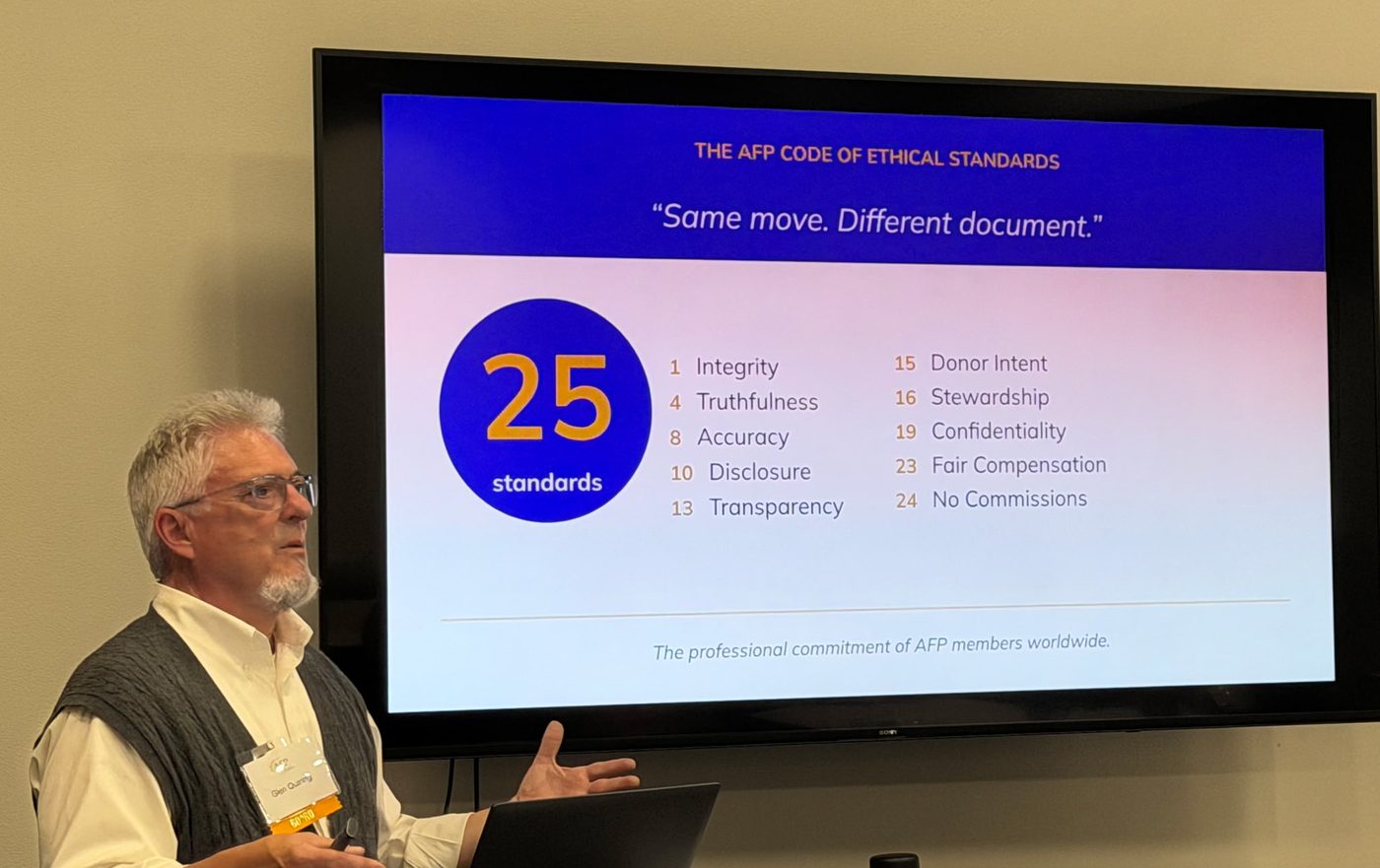
I’m Glen Quiring, CFRE, and I am responsible for Show Me the Receipts. I’m a Certified Fund Raising Executive, and I came to this argument the long way: through the Lilly Family School of Philanthropy and years spent creating development solutions, during which I watched development departments suffer from a lack of effectiveness that nobody could really name despite upholding the very popular mantra “fundraising is about relationships.” That unexplained loss is where this framework comes from. My work at the Pacific Conservatory Theatre and the Allan Hancock College Foundation and my own practice at Clearview Philanthropy is where it gets put to use.
I want to be careful about my own place in it, because it bears on how you should read a page like this. If trust is institutional rather than personal, then you shouldn’t trust this framework, since I’m the one making the case. You should trust it because it holds up. My job isn’t to be the charismatic source of a good idea. It’s to be the person accountable for the claim: the one who put his name on it, who will defend the parts that are defensible and correct the parts that aren’t. Author and steward, not guru.
How I read the field
When someone credits a fundraiser’s warmth for a major gift, or blames a departed staffer for a donor who left, I ask a different question: was that person the source of the outcome, or the channel that carried it? Most of what we call the relationship is a channel. It makes an institution’s integrity legible to the donor. It does not create it. The gift the warm officer landed was usually planted years earlier by promises the institution kept, or lost years earlier by promises it broke.
The claim
Show Me the Receipts makes one argument. Durable donor trust is not manufactured inside the relationship between a fundraiser and a donor. It is the accumulated record of promises an institution made and kept.1 The fundraiser carries those promises. The fundraiser is not the source of the trust they earn.
Warmth is real and worth having, but no major gift has ever arrived because of it, and none has left for lack of it. What moves trust rightward, year over year, is receipts.2
What this site is
This is the permanent home of that argument. The Field Notes work it out in public, one observation at a time, honest about what the research establishes and what is still hypothesis. The instruments let practitioners act on it inside their own shops. The short version travels in rooms and on LinkedIn. The full case lives here.
Where it stands in the field
None of this replaces good fundraising practice. It adds a layer underneath it.5 The argument stands on established shoulders: Adrian Sargeant on trust, commitment, and satisfaction as the drivers of donor loyalty; Ken Burnett on relationship fundraising; Chris Argyris on how organizations learn, or fail to, when something breaks.3
It takes those threads and asks a question the field never quite operationalized: when a donor leaves, can you trace the broken promise that lost them? Most shops cannot. That gap is the work.4
How this site handles claims
Show Me the Receipts distinguishes what is documented from what is inferred, and it flags its own hypotheses as hypotheses. Where a number is softer than it sounds, it says so. This is a place to think about the problem rigorously, not a funnel. If the argument is wrong somewhere, this site would rather find out than defend it.
Bring it to your chapter or conference
Show Me the Receipts is also a keynote: a 60-minute, story-driven talk in three acts — Naming, Tracing, and Repairing — written for fundraising professionals and the directors who lead them. The room doesn’t leave with theory. It leaves with a way to see the failure that quietly costs them donors, and one repair they can make in the next thirty days. The content is designed to align with the CFRE competency areas of Relationship Building and Leadership and Management.
If you program an AFP chapter, a regional conference, or a staff development day, I’d welcome the conversation.
contact@showmereceipts.orgNotes: grounding in the field’s foundational curriculum
- Modules 4 and 7, AFP Fundamentals of Fundraising Course. Module 4, Building & Sustaining Relationships, teaches that relationships are the foundation of fundraising and begin with knowing the donor. Module 7, Management & Accountability, covers records management, gift processing, program evaluation, and accountability. This framework locates the trust the field places in Module 4 within the machinery of Module 7. It relocates the source of that trust; it does not reject the relationship. ↩
- Module 5, Securing the Gift. The curriculum’s solicitation module covers the ask for annual and major gifts. The warmth-versus-trust distinction is a claim about what secures the next gift and the one after: not the solicitation moment, but the record of promises kept between asks. ↩
- Module 1, Overview of Fundraising. The opening module introduces why people give and the foundations of the field, including the donor-retention research the profession now teaches. This framework draws its retention premise from that same ground; the named scholars are its intellectual lineage. ↩
- Modules 4 and 7, extended. Module 4 addresses sustaining relationships and Module 7 addresses program evaluation, but neither the introductory curriculum nor its advanced counterparts teach causal tracing: following a lapse back to the specific process failure that produced it. This is the capacity the framework proposes to add above the existing competencies, not a correction to them. ↩
- The seven modules, as a whole. Modules 1 through 7 describe the field’s foundational competencies. Show Me the Receipts adds a capacity beneath them rather than substituting for any. Locating the argument against this curriculum situates it relative to the field’s own teaching; it does not imply endorsement by AFP. ↩